
NICU
NICU
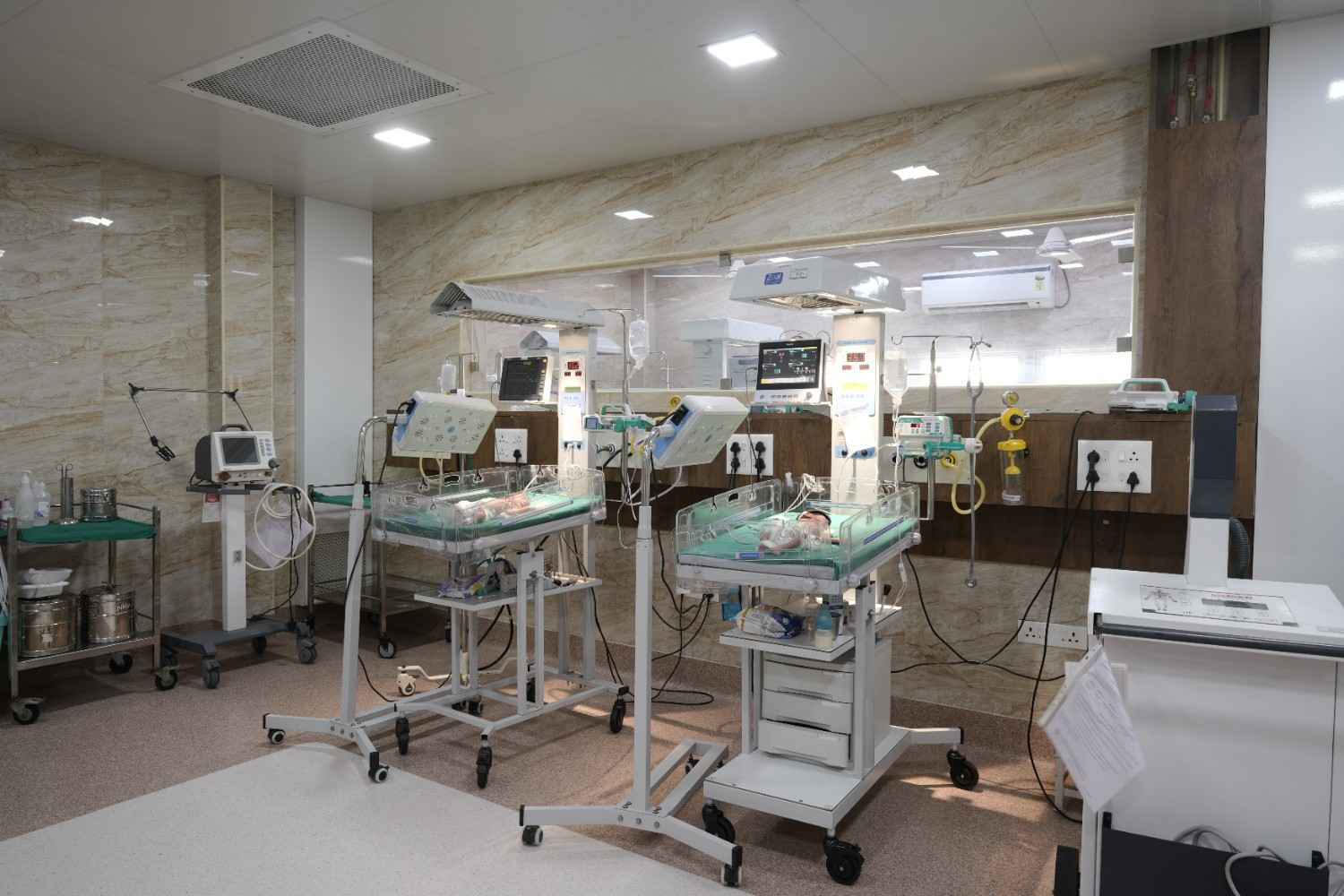
Newborn services typically include
Initial examination: A thorough check-up within the first 24 hours of birth
Feeding support: Help with breastfeeding, formula feeding, and addressing feeding issues
Growth monitoring: Regular weight and length checks
Vaccinations: Administration of hepatitis B and BCG vaccines
Screening tests: Hearing, metabolic, and other screenings as required
Parent education: Guidance on newborn care, safety, and development
Normal Newborns-Delivery and assessment
Every delivery is attended by a resuscitation team which consists of a Neonatologist/Paediatrician and atleast two nurses trained in newborn care.
Before preparing to receive a baby, the team assesses whether the pregnancy is high-risk or low-risk and arrangements are made depending on that. If the baby is normal after birth, we do not hurry to cut the umbilical cord. We let the baby stay on the mother’s chest or abdomen for one to three minutes before cutting the cord. This ensures that the baby gets additional blood from the placenta during that time and this is of huge benefit to the baby. This additional blood not only confers short term benefit but also reduces the incidence of anaemia in infancy. During this time, the baby doctor and nurse are at the baby’s side and will be doing an ongoing assessment of the baby. Once the cord is cut, the baby is taken to the resuscitation area for a few minutes to do a complete examination and to check the birth weight. All normal babies are then taken back to their mother for skin-to-skin care and early breastfeeding.
Breastfeeding
We are a breast-feeding friendly hospital and do all that is possible to ensure that new moms and babies can have a positive experience with regards to feeding. There are trained nurses who help mothers with the feeding positions and latching. There is a trained lactation nurse who does lactation rounds on every mom daily. The Paediatricians/ Neonatologists also supervise and manage any feeding problems. We are happy to say that most twin babies born in our hospital go home on exclusive breast feeds and stay on breast feeds for more than a year. Regular antenatal and postnatal classes are also being conducted on normal new-born care and breastfeeding.
Normal new-born Care
There are certain routine tests that are performed on all babies delivered at our hospital.
- Hearing screen: The hearing screen tests if the baby can hear sounds normally in both ears. The incidence of congenital hearing loss (i.e., hearing loss present at birth) is estimated to be one out of every 1,000 live births. Universal new-born hearing screening is now recommended by almost all countries in the world. This is a very simple, non-invasive test which takes about 5-10 minutes to perform. The testing is done by a certified Audiologist on the second or third day after baby is born.
- Testing for new-born jaundice: All new-borns develop some jaundice on day 2-3 after birth which increases till day 5-6 and then starts coming down. This jaundice unlike jaundice in adults is not a disease. It is usually self-limited and does not require treatment. However, if the level of jaundice is above a certain cut-off limit, it might need treatment with phototherapy (blue lights kept above the baby’s bed). To ensure we do not miss such high levels, we routinely test all babies on the second or third day.
- New-born Screening Test: This screens your baby for 5 common conditions that can be picked up at birth- Congenital Hypothyroidism, Galactosemia, Cystic Fibrosis, G6PD deficiency and Congenital Adrenal Hyperplasia. If found to be positive, these may need immediate treatment. The results of this test take 10-15 days and will be given to you at your follow-up visit.
- Echocardiography screening: This test will be done before discharge to rule out any cardiac conditions in your baby.
- Vaccinations: All babies will be vaccinated with BCG, Hepatitis B and OPV (Polio vaccine) before discharge.
- All the above tests ensure that we send home a healthy and happy baby.
Neonatal Intensive Care Unit (NICU)
The Neonatal Intensive Care Unit (NICU) at Women’s Center is a 14 bed, state-of-the-art level 3 unit which is well equipped to admit and manage all high-risk new-borns. The unit has facilities to
- Manage extreme preterm infants born as early as 24-26 weeks
- Perform neonatal surgeries and provide post-operative care
- Multidisciplinary management of babies with congenital anomalies
- Professional training and equipment to perform in house cranial ultrasounds and Echocardiography
- Ventilate and manage babies with severe PPHN
- Transport sick new-borns from peripheral hospitals in a specially equipped transport incubator
- Prepare TPN (total parenteral nutrition) within the unit under a laminar flow
- Handle any neonatal emergency 24/7
- High risk Perinatal follow up of preterm infants
- Store and handle expressed breast milk hygienically
All neonatal services are provided at an affordable cost.
The NICU team consists of Neonatologists trained from some of the best centres in India and Canada. They are well experienced in treating sick new-borns who require level 3 care and have successfully managed preterm as young as 23 weeks and weighing 500 g. The NICU and Paediatric registrars who provide round the clock cover have a minimum of one-year specialized training in Neonatology. Our team of nurses are very efficient and well trained in handling new-borns. We regularly upgrade our standards and knowledge with frequent grand rounds, bedside teaching, monthly perinatology meetings and infection control committee meetings.
We have had several success stories in the NICU in the past 5 years. All NICU graduates being followed up by us are doing extremely well. We are a very family friendly unit and believe that parents are as much part of the treating team as doctors and nurses. We involve them in all our daily rounds and decisions. Parents of babies in our unit usually tend to stay by the baby’s bedside throughout the day and spend most of their time doing skin-to-skin care. We are very proud of the fact that our preterm breastfeeding rates are one of the best in the whole country.




FAQ
A NICU (Neonatal Intensive Care Unit) is a specialized unit designed to care for newborns who need extra medical support after birth. Babies may require NICU care if they are born premature, have low birth weight, breathing difficulties, infections, or complications during delivery. The goal is to provide close monitoring and advanced care to help babies stabilize, grow stronger, and recover safely.
Yes, the NICU is the safest place for babies who need specialized care. Newborns are monitored continuously with advanced equipment that tracks vital signs like heart rate, breathing, and oxygen levels. A dedicated team of specialists ensures immediate attention and support, giving your baby the best chance for a healthy recovery.
The length of stay depends on your baby’s condition, maturity, and response to treatment. Some babies may need only a few days of observation, while others—especially premature babies—may require longer care. The focus is on ensuring your baby is stable, feeding well, and ready to go home safely before discharge.
Yes, parental involvement is encouraged as it plays an important role in your baby’s recovery. Parents can visit, stay informed about their baby’s progress, and participate in care activities like feeding or skin-to-skin contact when possible. This not only supports the baby’s development but also helps parents feel more confident and connected.
NICUs are equipped with advanced technology tailored for newborn care, including incubators to maintain body temperature, ventilators for breathing support, and monitoring systems to track vital signs. Babies may also receive IV fluids, medications, or specialized feeding support. These treatments help stabilize and support newborns until they are strong enough to function independently.